

For brands sourcing yoga mats, "thickness" often gets treated as a simple spec line on a purchase order. In practice, it's one of the most consequential decisions in the entire product development process. Get it wrong, and you end up with a mat that wobbles under standing poses, feels punishing on the knees, or bulks up your packaging costs beyond what your price point can bear. Get it right, and thickness becomes a genuine differentiator between your product line and everyone else's.
This guide breaks down what thickness actually means in yoga mat manufacturing, how it affects performance, and what to consider when briefing a supplier — so your next sourcing decision is based on data, not guesswork.
What "Thickness" Means in Yoga Mat Specifications
Thickness sounds straightforward, but in manufacturing terms it's a range, not a fixed point. Every mat carries a manufacturing tolerance — the acceptable deviation from the stated thickness — and that tolerance affects everything from how the mat feels underfoot to how consistently it performs across a production run.
Standard Thickness Ranges (mm) in the Market
The yoga mat market generally clusters around four thickness categories, each associated with a distinct use case:
| Thickness Range | Common Category | Typical Use Case |
|---|---|---|
| 1.5–2mm | Travel / Ultra-thin | Frequent travelers, foldable mats, layered over studio mats |
| 3–4mm | Standard / Studio (EVA GLORY core production range) | General practice, balance-focused styles (Vinyasa, Ashtanga) |
| 5–6mm | Cushioned / All-purpose (EVA GLORY core production range) | Home practice, mixed-level studios, joint-sensitive users |
| 8mm+ | Extra-thick / Therapeutic | Restorative yoga, floor-based fitness, older or injury-prone users |
Brands developing a multi-SKU product line often need to cover more than one of these categories, which makes understanding the performance trade-offs at each range essential before finalizing a spec sheet.
How Thickness Affects Stability, Comfort, and Portability
Why Yoga Mat Thickness Affects Stability
Stability is largely a function of how much the foam compresses and shifts under load. Thinner mats keep the practitioner's foot closer to the floor, reducing the sensation of "sinking" during standing or balance poses. This is why competitive and alignment-focused disciplines — where a wobbling surface directly undermines performance — tend to favor mats in the 3–4mm range.
Thicker mats, by contrast, introduce more foam between the foot and the ground. Depending on the foam's density and cell structure, this can translate into a softer, less responsive base, which some practitioners experience as reduced stability during single-leg or inversion poses.
The Trade-off Between Cushioning and Balance
There is no thickness that maximizes both comfort and stability simultaneously — it's an inherent trade-off. A thicker mat cushions joints and pressure points, which matters for restorative practices, older users, or anyone practicing on hard flooring. A thinner mat sacrifices some of that cushioning in exchange for a firmer, more grounded feel.
For brands, this means thickness should never be chosen in isolation from the intended practice style and user profile. A single "universal" thickness across an entire product line often satisfies no one particularly well.
Matching Thickness to Use Case and End-User Segment
Studio / Fitness Center Use
Studios prioritize durability and consistent performance across heavy daily use, and they typically standardize around the 3–5mm range. Mats in this band offer enough cushioning for comfort during longer sessions while maintaining the grounded feel needed for standing sequences and balance work.
Travel and Retail Consumer Products
Retail and travel-focused product lines skew toward two extremes: ultra-thin (1.5–2mm) foldable mats built for portability, or 6mm+ cushioned mats marketed toward home practitioners who prioritize comfort over portability. Brands targeting the retail consumer segment often benefit from offering both ends of this spectrum rather than a single middle-ground SKU.
Sourcing Considerations Beyond Thickness (Density, Material, Tolerance)
Thickness alone doesn't determine how a mat performs — foam density and manufacturing tolerance matter just as much, and they're where many sourcing decisions quietly go wrong. Two mats stamped with the same "6mm" spec can feel completely different if one is produced with a tighter tolerance than the other.
Where Precision Gets Lost in Production
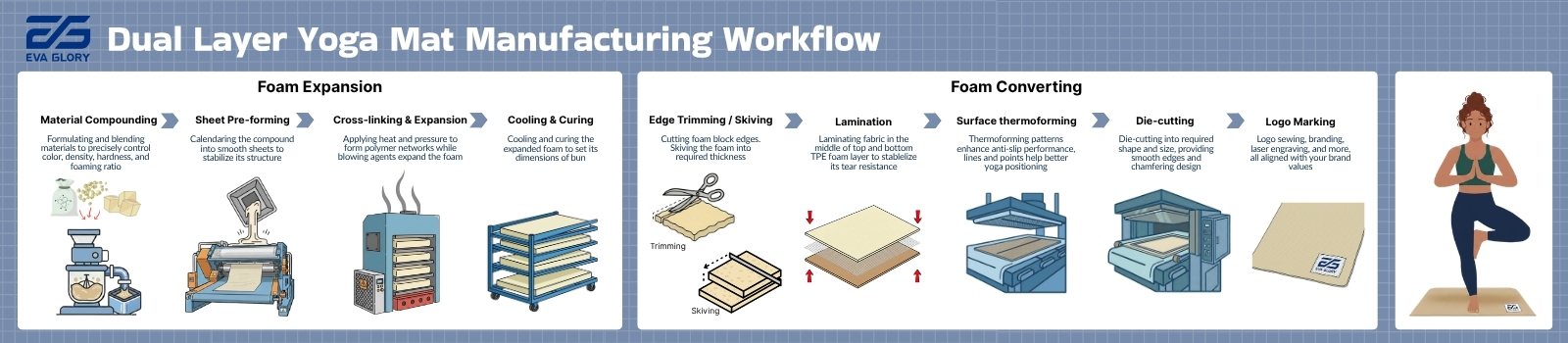
This is particularly important at scale, and tolerance isn't determined at a single point in production — it accumulates across several stages. Foaming sets the baseline cell structure and density; skiving (slicing the foam block into sheets) determines how evenly that thickness is cut across the sheet's width; and surface embossing, where texture is pressed into the mat, can either hold that tolerance or quietly erode it if the pressing process isn't tightly controlled. A supplier that manages all three stages in-house has far more room to catch and correct drift before it reaches a finished mat.
What to Ask Suppliers Before Placing an Order
A tolerance of ±0.5mm across a full production run — held consistently through foaming, skiving, and embossing — is a reasonable benchmark for buyers to ask about. EVA GLORY, a TPE foam manufacturer, works within this tolerance range as a baseline across those combined stages, which is a useful reference point when evaluating whether a potential supplier's stated specifications will actually hold up across large orders, not just on a sample piece.
For brands, the practical takeaway is to ask suppliers not just "what thickness can you produce," but "what tolerance can you guarantee across a full production batch."
TPE Foam Technology and Thickness Consistency in Production
How Foam Density Control Affects Thickness Precision at Scale
Thickness consistency starts at the foaming stage. TPE foam is produced by heating the compound with a blowing agent, which causes it to expand uniformly into a foam block. How evenly that expansion happens across the block directly determines whether the resulting foam holds a consistent density, and therefore a consistent thickness, once it's sliced into sheets. Uneven expansion at this stage is one of the most common — and least visible — causes of thickness drift that only becomes obvious later, once mats are finished and compared side by side.
Why Skiving & Processing Equipment Precision Matters as Much as Foaming
Foaming is only the first half of the equation. After a foam block is produced, it typically needs to be skived — sliced into precise sheets — before it becomes a usable mat. The precision of the skiving equipment used at this stage has just as much influence on final thickness accuracy as the foaming process itself. A supplier with excellent foam formulation but inconsistent skiving equipment will still produce mats with noticeable thickness variation, batch to batch.
Why Surface Texturing Through Thermoforming Doesn't Have to Compromise Thickness
Most yoga mats get their grip through a textured surface pattern, typically applied via thermoforming or embossing — pressing a heated pattern into the foam's surface after it's been cut to thickness. This step is where thickness accuracy is most often lost without buyers realizing it: uneven pressing pressure or poorly calibrated heat across the mold can leave a mat with a consistent stated thickness on paper but noticeable high and low spots once texture is applied. Done correctly, thermoforming adds anti-slip texture without measurably altering the sheet's underlying thickness — but that requires the pressing equipment and heat control to be dialed in as precisely as the foaming and skiving stages that come before it.
Why One-Stop Manufacturing Reduces Compounding Errors
This is where sourcing from a supplier with integrated, one-stop manufacturing — foaming, skiving, embossing, and finishing under a single roof — offers a meaningful advantage. When these stages are split across separate vendors, small deviations compound at each handoff, and accountability for thickness issues becomes hard to trace back to a single cause. EVA GLORY's in-house foaming, skiving, and embossing capability, paired with quality checks between each stage, is structured specifically to prevent this compounding effect and hold thickness within ±0.5mm across a full production run.
For brands developing multiple SKUs, this also opens the door to genuine customization — such as a single-layer 6mm construction versus a dual-layer 3mm+3mm composite — without having to coordinate across multiple external suppliers to get there.
Click here to learn more about our Yoga Mat Manufacturing Process

