
Marine EVA Foam Sheet Density and Hardness Explained: What Boat Builders Need to Know
Marine flooring buyers often start their search with a single question: how firm does this foam need to be? But hardness on its own only tells part of the story. In marine EVA foam sheets, density and Asker C hardness tend to move together, and both are important indicators of how a sheet will perform in a given application. For boat builders, installers, and procurement teams sourcing custom marine EVA foam sheet, treating both specifications as equally important checkpoints — rather than focusing on hardness alone — helps avoid costly material mismatches.
Why Density and Hardness Matter for Marine EVA Foam
Understanding Foam Density
Density describes how tightly the cell structure of a marine EVA foam sheet is packed, typically measured in g/cm³ (or kg/m³). It is the first specification most experienced buyers check, because it influences nearly every other performance factor: hardness, load-bearing capacity, buoyancy, and resistance to compression over time.
A low-density marine EVA foam has a more open, springy cell structure, which makes it lighter and softer underfoot. A high-density foam is more tightly packed, giving it greater rigidity, better wear resistance, and a longer service life under repeated foot traffic. In marine applications, where flooring is exposed to constant movement, sun, and moisture, density is one of the key indicators — alongside hardness — for anticipating how a sheet will hold up over time.
Understanding Asker C Hardness
Asker C is the most commonly used hardness scale for marine EVA foam sheet, measuring a material's resistance to indentation on a 0–100 scale. Unlike Shore A, which is calibrated for solid rubber, Asker C is better suited to the compressible, cellular structure of foam, making it the standard reference for marine decking and flooring applications.
Asker C hardness and density tend to move together in marine EVA foam, and the two specifications should always be read side by side rather than in isolation. A low Asker C rating is commonly seen alongside a lower-density formulation, while a high Asker C rating is commonly seen alongside a denser, more compact material — but neither figure on its own guarantees the right material for the job. Buyers requesting "hardness" from a supplier without also specifying density risk receiving a sheet that meets the hardness number but underperforms structurally.
The table below shows how density and Asker C hardness typically appear together in marine EVA foam sheets, along with the performance characteristics associated with each range.
| Density Range | Asker C Hardness | Feel | Typical Performance |
|---|---|---|---|
| 0.10–0.15 g/cm³ | 30–45 | Soft, cushioned | High comfort, lower wear resistance |
| 0.15–0.18 g/cm³ | 45–50 | Medium | Balanced comfort and durability |
| 0.18–0.25 g/cm³ | 50–65 | Firm | High wear resistance, lower cushioning |
Table 1: Typical density and Asker C hardness ranges in EVA marine foam sheets. Actual values vary by formulation and manufacturer.
How Density and Hardness Together Affect Comfort, Grip, and Durability
Density and hardness each pull the foam's performance in a different direction, and the right balance between the two depends on how a boat's flooring will actually be used. Softer, lower-density foam absorbs impact and feels more comfortable for bare feet, but it compresses faster under repeated pressure. Firmer, higher-density foam holds its shape longer and resists gouging from gear or hardware, but can feel less forgiving on long days aboard.
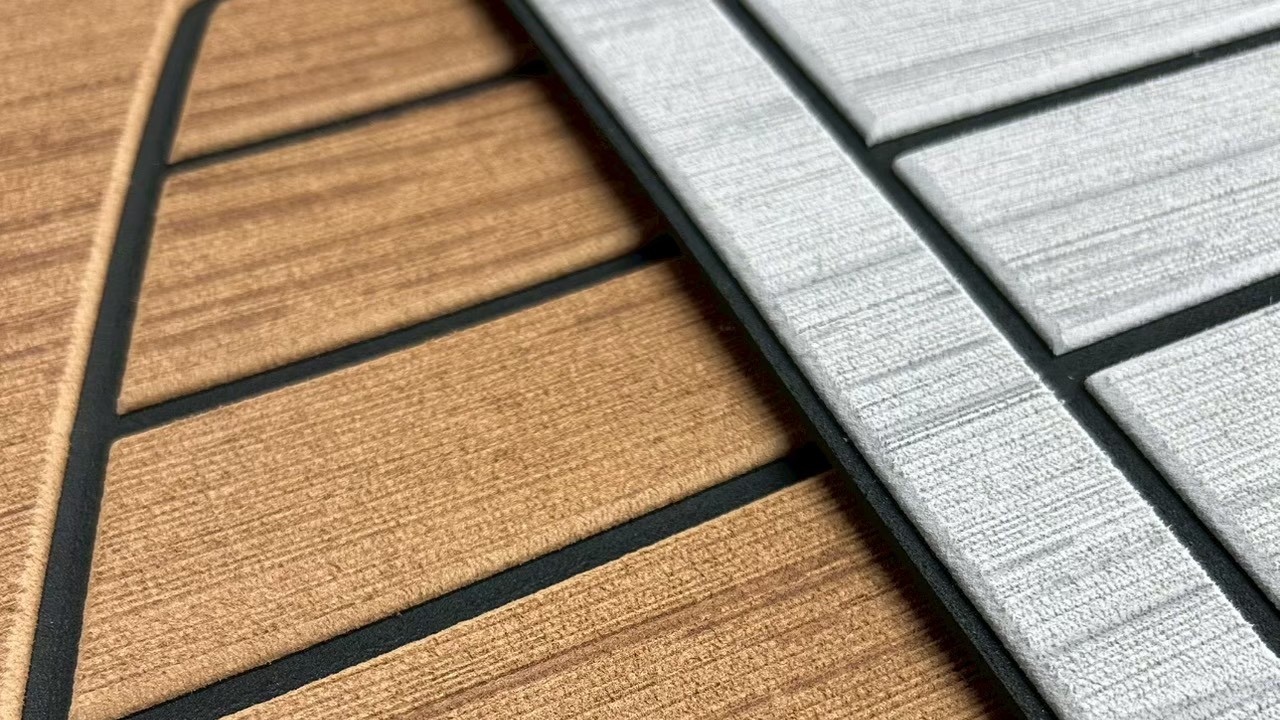
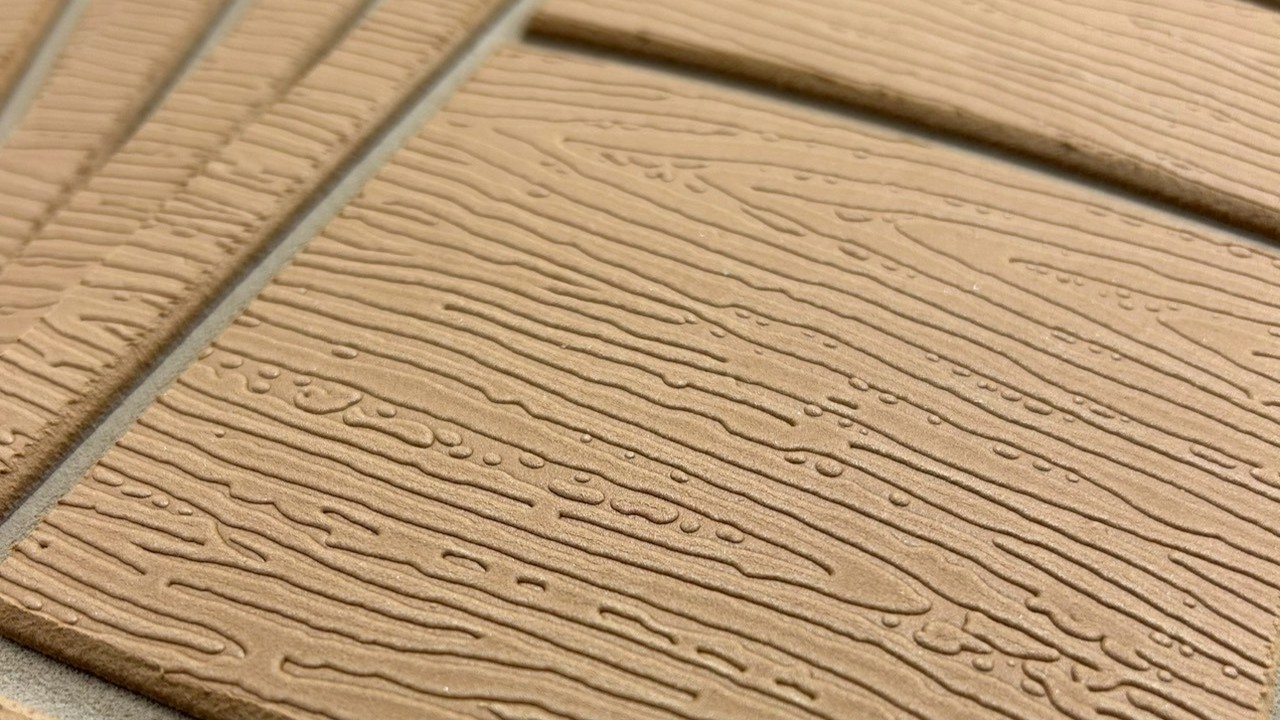
Grip performance is influenced by both specifications as well. Lower-density foam tends to conform more closely to the foot, improving traction in wet conditions, while higher-density foam relies more on surface texture — such as diamond or teak-pattern grooving — to maintain slip resistance.
[Marine EVA foam surface texture and non-slip grooving options]Recommended Density and Hardness Ranges by Boat Type and Application
Choosing between softer and firmer marine EVA foam sheet comes down to matching the material's density and Asker C hardness to how — and where — it will be used on the vessel.
Lower-Density, Softer Foam (Density ~0.10–0.15 g/cm³, Asker C ~30–45)
This range is best suited to areas where comfort and cushioning take priority, such as swim platforms, cockpit sole padding, and lounge or seating areas. The lower density reduces overall weight, which is a meaningful advantage on smaller recreational boats, and the softer feel is well suited to barefoot use around water. The trade-off is a shorter lifespan under heavy, repeated foot traffic compared to denser alternatives.
Higher-Density, Firmer Foam (Density ~0.18–0.25 g/cm³, Asker C ~50–65)
Higher-density foam is the better choice for high-traffic zones such as helm stations, walkways, bait station surrounds, and commercial deck areas where durability outweighs cushioning. This range resists compression set, holds up better against dropped gear and hardware, and maintains its dimensional stability over longer service periods — an important factor for boats in daily commercial use.
Recreational Boats vs Commercial Vessels
Recreational boats generally lean toward the lower-to-mid density range, since weight savings and onboard comfort are higher priorities for weekend and leisure use. Commercial vessels — including charter boats, fishing fleets, and workboats — typically specify higher-density, firmer foam, since flooring is subjected to far more frequent loading, foot traffic, and equipment contact over the vessel's operating life. Matching density and hardness to expected duty cycle, rather than comfort preference alone, is one of the most common adjustments experienced buyers make after initial sea trials.
The table below maps common marine EVA foam density ranges to the boat applications they typically suit.
| Density Range | Asker C Hardness | Typical Applications |
|---|---|---|
| 0.10–0.15 g/cm³ | 30–45 | Swim platforms, cockpit sole padding, lounge and seating areas |
| 0.15–0.18 g/cm³ | 45–50 | General deck areas, mixed-use recreational flooring |
| 0.18–0.25 g/cm³ | 50–65 | Helm stations, walkways, bait station surrounds, commercial decking |
Table 2: Common marine EVA foam density ranges mapped to typical boat flooring applications.
Other Specifications to Check Alongside Density and Hardness
Density and hardness are foundational, but they don't tell the full story of how a marine EVA foam sheet will hold up over time.
UV Resistance and Compression Set in Saltwater Environments
Marine EVA foam is continuously exposed to UV radiation, saltwater spray, and temperature fluctuation, all of which accelerate material breakdown if the formulation isn't engineered for outdoor and marine use. UV-stabilized foam resists discoloration, surface chalking, and premature brittleness far longer than standard-grade EVA. Compression set — the foam's ability to recover its original thickness after sustained pressure — is equally important in saltwater environments, since repeated wet-dry cycling can accelerate permanent deformation in lower-quality materials. Buyers should request UV resistance and compression set data alongside density and hardness figures, particularly for vessels operating in high-sun or tropical climates.
Why Spec Sheet Numbers Can Vary Between Suppliers
A complete marine EVA foam sheet spec sheet should list density and Asker C hardness side by side — but where those numbers actually come from matters as much as the numbers themselves. When raw foam production, lamination, and CNC fabrication are handled by separate vendors, small deviations in density, hardness, and color can go uncaught until the deck pads reach final assembly, which is a common reason two "identical" spec sheets from different suppliers don't perform the same way in practice.
Spec sheets from an integrated, one-stop manufacturer — where formulation, lamination, and CNC cutting all happen under a single roof — tend to stay more consistent from batch to batch, since one facility controls quality from raw pellet through finished pad rather than passing the material between multiple vendors.
Working with a Manufacturer to Get the Right Spec
Selecting the right combination of density and hardness is rarely a one-size-fits-all decision — it depends on boat type, deck zone, climate exposure, and expected duty cycle. This is where working with a manufacturer that controls the full process, from raw material formulation to CNC fabrication, makes the biggest difference. During compounding and cross-linking, EVA/PE pellets are precisely blended and expanded to hit a target density, UV resistance, and closed-cell structure — this early-stage formulation is what ultimately determines the Asker C hardness a finished sheet will land at.
A manufacturer with in-house R&D and fabrication capabilities can adjust this formulation within a custom range for a specific application, rather than forcing boat builders to choose between standard off-the-shelf options. This level of control — from raw pellet to finished, CNC-cut deck pad — helps ensure the flooring maintains stable comfort, grip, and durability across the full operating lifespan of the vessel.
[See how EVA GLORY's one-stop manufacture works]The table below shows typical density, hardness, and durability specifications across three of our standard marine EVA foam grades.
| Spec | DX45 | DX55 | DX65 |
|---|---|---|---|
| Hardness (Asker C) | 40–50 | 50–60 | 60–75 |
| Density (g/cm³) | 0.11–0.15 | 0.145–0.18 | 0.19–0.23 |
| Water Absorption (g/cm³) | <0.002 | <0.002 | <0.002 |
| Compression Set (%) | <16 | <10 | <9 |
Table 3: Standard density, hardness, and durability specifications for EVA GLORY's DX45, DX55, and DX65 marine foam grades.
Looking for marine EVA foam sheets engineered to a precise density and hardness for your boat's specific application?
Talk to Our Foam SpecialistsFAQ
What is the difference between density and Asker C hardness in marine EVA foam?
Density measures how tightly the foam's cell structure is packed, typically in g/cm³, while Asker C hardness measures the material's resistance to indentation. The two properties tend to move together in marine EVA foam, but each provides different information — density relates more to weight and long-term wear, while hardness relates more to surface feel and grip.
What density range is best for boat swim platforms and cockpit padding?
A lower-density range of approximately 0.10–0.15 g/cm³, corresponding to an Asker C hardness of roughly 30–45, is generally best suited to swim platforms and cockpit sole padding. This range offers a softer, more cushioned feel for barefoot use around water, though it wears faster than denser alternatives.
Do commercial boats need higher-density marine EVA foam than recreational boats?
Generally yes. Commercial vessels such as charter boats and workboats experience more frequent foot traffic and equipment contact, so they typically specify higher-density, firmer foam (around 0.18–0.25 g/cm³, Asker C 50–65) for better durability. Recreational boats can often use lower-to-mid density foam, prioritizing comfort and weight savings.
What other specifications should I check besides density and hardness?
UV resistance and compression set are particularly important for marine environments, since sun exposure and repeated wet-dry cycling from saltwater can accelerate material breakdown. It's also worth confirming tolerance ranges for density and hardness, since batch-to-batch consistency tends to be tighter when a manufacturer controls formulation and fabrication in-house rather than sourcing from multiple vendors.
For a marine foam sheet processing facility, besides hardness and density, what other indicators matter during processing?
Tensile strength and tear strength are two key indicators of processing stability. EVA GLORY's marine EVA foam sheets meet tensile strength ≥20 kg/cm² (ASTM D412) and tear strength ≥15 kg/cm (ASTM D624), so they hold up consistently through CNC cutting and shaping with minimal risk of tearing or defects. Because our foam passes these thresholds, processing facilities see less rework and scrap, keeping production capacity focused on finished output rather than correcting errors.
Density and hardness are the main factors to consider when choosing a foam sheet, but what else affects how smoothly it installs?
Dimensional stability plays a major role in installation smoothness. EVA GLORY's foam is verified through dual testing — a lab simulation at 70°C for 24 hours, plus real-world outdoor Jungle Testing — and passes both with shrinkage of only 0.5–2mm. Because our foam meets this standard, installers see fewer seam gaps and less edge lifting after installation, which helps avoid rework and on-site repair costs once the flooring is in place.

