
Reviewed By: R&D Team
Key Takeaways
- Foam hardness must be specified per insole zone, not per insole.
- The medial arch for flat feet needs the firmest, highest-density foam.
- The heel cup needs medium hardness to balance stability and shock absorption.
- The forefoot and metatarsal area needs the softest foam for pressure relief.
- High-arch feet need conforming medium foam, not the softest option.
- Verify hardness with ASTM D2240 and compression set with ASTM D395 or a foam-specific method.
- Dual-density construction applies zone-specific hardness in a single insole.
Why One Foam Hardness Cannot Serve the Entire Insole
A single foam hardness fails because each zone of the foot carries a different load and has a different job. The medial arch must resist collapse, the heel must absorb impact at initial contact, and the forefoot must spread pressure during push-off. For procurement and R&D teams, orthopedic insole foam hardness is therefore a zone-level specification, not a product-level one.
Uniform foam forces a compromise. A firm foam that supports a collapsed arch will feel harsh under the metatarsal heads, while a soft foam that relieves forefoot pressure will bottom out under the arch. Dual-zone and multi-density builds solve this by assigning each region its own material window.
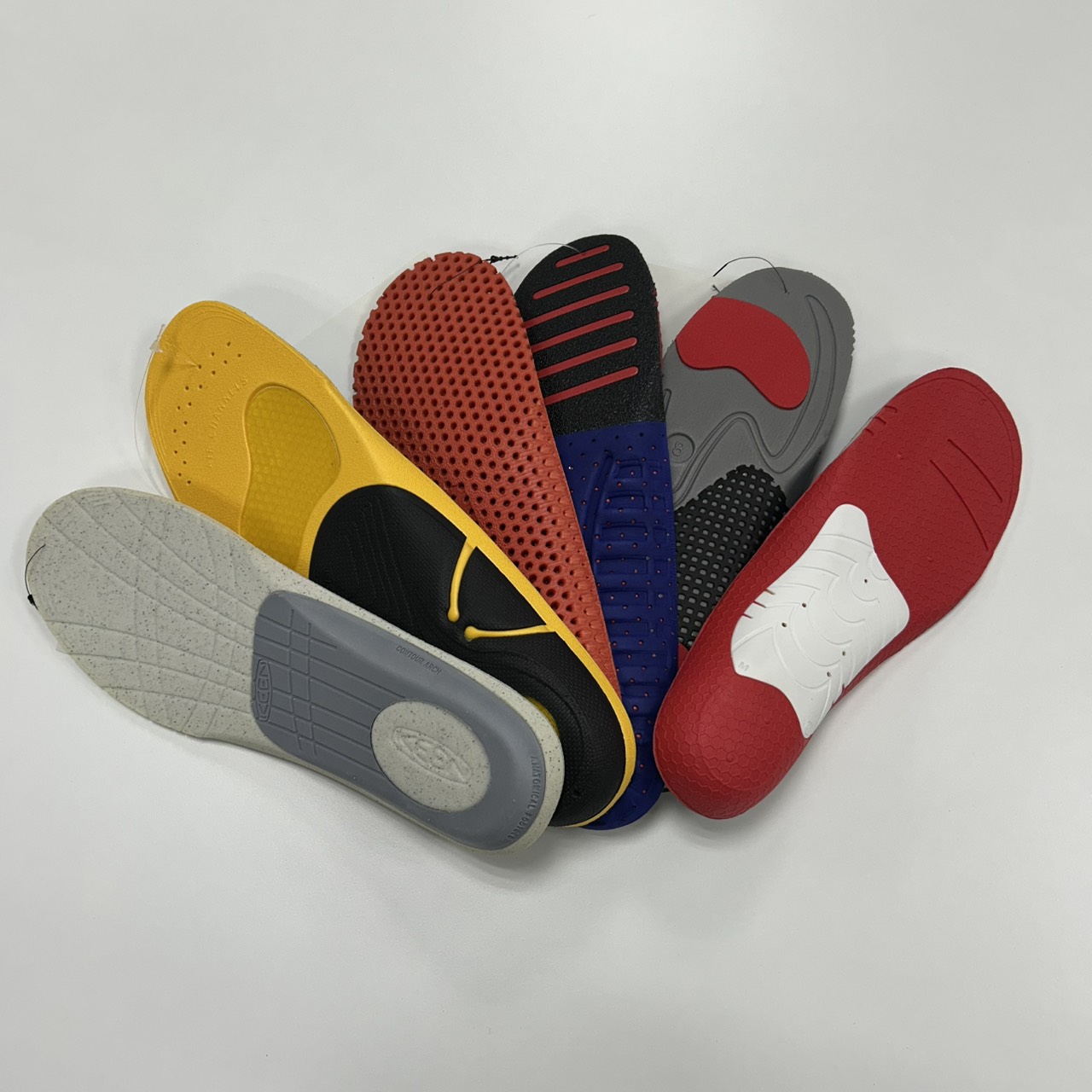
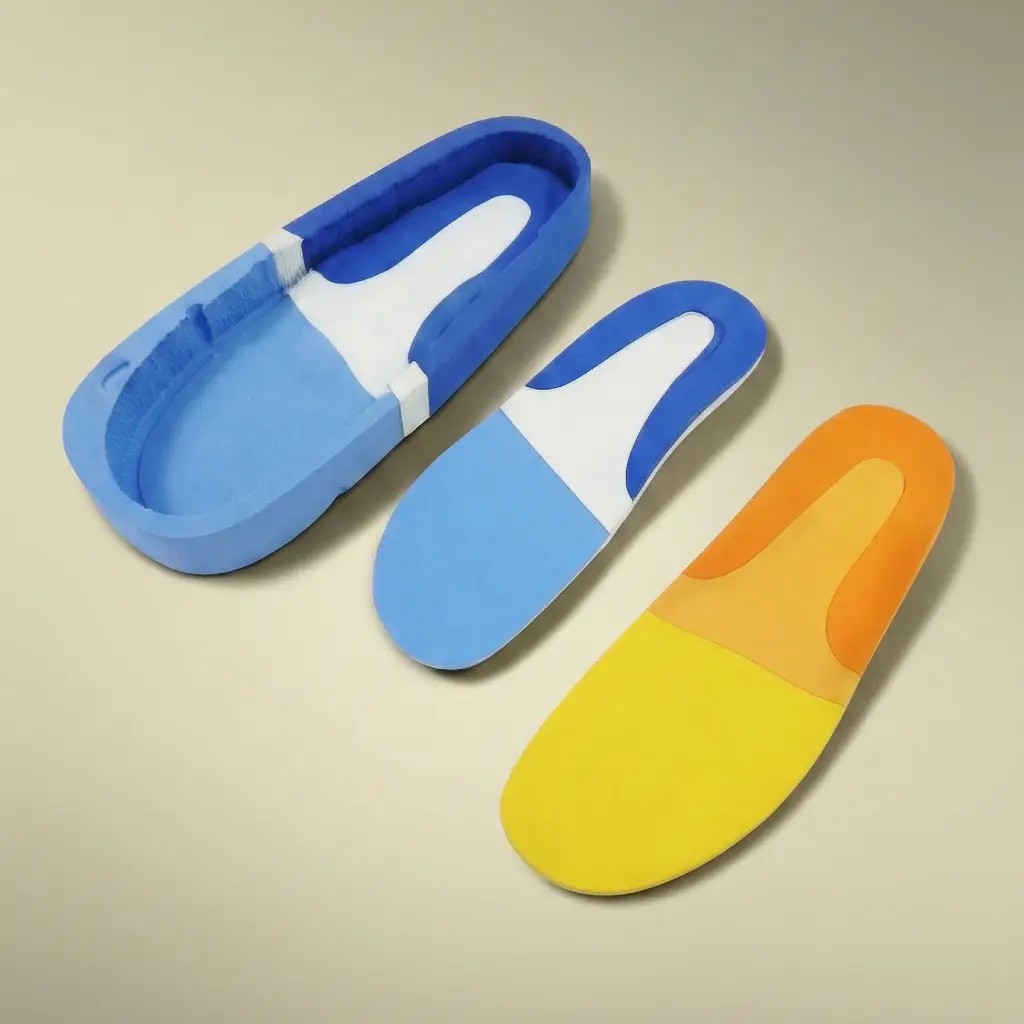
Recommended Foam Hardness and Density by Insole Zone
The right hardness window depends on the zone, the foot type, and the foam family, so every range below is a starting point for validation, not a final specification. Hardness is typically reported in Shore A, while density is reported in g/cm³, and the two interact: higher density generally raises hardness and lowers compressibility for closed-cell EVA and cross-linked polyethylene.
Medial Arch: Firmer, Higher-Density Foam for Flat Feet and Arch Collapse
The medial arch of a flat foot needs the firmest foam in the insole. Foam hardness for flat foot insoles must be high enough to resist deformation under body weight, otherwise the arch flattens the support within weeks. Arch support foam density is the second lever: a denser cell structure holds its shape under repeated loading and keeps compression set low.
This firmness has a limit. Foam that is too hard transfers load to a small contact area and causes discomfort, so many designs pair a firm arch core with a thin softer top layer.
Heel Cup: Balancing Stability and Shock Absorption
The heel cup requires medium hardness because it must both stabilize the calcaneus and absorb heel-strike shock. A heel cup foam hardness that is too soft allows the heel to roll inside the cup, while one that is too firm reduces shock absorption. Medium-density, closed-cell foam with good rebound is the usual choice, and thickness is often increased here rather than hardness.
Forefoot and Metatarsal Area: Softer Foam for Pressure Relief
The forefoot should use the softest foam in the insole to relieve peak plantar pressure. Metatarsal pad foam softness matters most for diabetic and neuropathic footwear, where localized pressure can lead to tissue damage. Lower-density foam in this zone also keeps the insole flexible during toe-off.
High-Arch (Cavus) Feet: Why Softer Is Not Always Better
High-arch feet need conforming medium-hardness foam, not the softest option available. A cavus foot has a small contact area, so the goal is to increase contact across the arch and midfoot to redistribute pressure. Foam that is too soft cannot hold that contour, while foam that is too firm leaves gaps and concentrates load at the heel and forefoot.
Zone-by-Zone Spec Table
The table below summarizes indicative starting windows for each zone, which should be confirmed with your own test data and the foam family you select.
| Insole Zone | Primary Function | Indicative Hardness (Shore A) | Indicative Density (g/cm³) | Key Priority |
|---|---|---|---|---|
| Medial arch (flat foot) | Resist collapse | Firm (about 50 to 65) | Higher (about 0.18 to 0.30) | Low compression set |
| Heel cup | Stability and shock absorption | Medium (about 35 to 50) | Medium (about 0.10 to 0.20) | Rebound and durability |
| Forefoot / metatarsal | Pressure relief | Soft (about 20 to 35) | Lower (about 0.08 to 0.15) | Cushioning and flexibility |
| High arch (cavus) | Increase contact area | Medium (about 30 to 45) | Medium (about 0.10 to 0.20) | Conformability |
Table: Indicative hardness and density windows by insole zone. Values are general reference ranges and must be validated against product testing data.
How to Verify Hardness and Density Before Approval
Verification should follow a defined test plan with fixed samples, fixed conditions, and written pass/fail criteria. Without this, supplier data cannot be compared batch to batch. A practical plan has four steps: define the sample, set the conditions, record the results, and apply the acceptance range.
Shore A Testing and Sample Conditions
Shore A hardness should be measured following ASTM D2240, the standard test method for rubber property and durometer hardness, which also covers cellular materials. The procedure presses a specified indentor into the specimen under defined force and reads the value within a set time, and specimens are generally about 6.4 mm thick.
- Sample: at least five specimens per lot, cut from the same zone-grade sheet, stacked only if a single piece cannot reach the required thickness.
- Conditions: condition samples at a fixed temperature and humidity before testing, and record both.
- Record: report the average and range, plus the durometer type and the reading time.
- Acceptance: compare each lot against the zone window in your purchase specification, for example a tolerance of plus or minus 5 Shore A.
Because soft foams can read unevenly, many QC teams also run a second hardness scale, such as Asker C, as a cross-check. Always state the scale in the contract.
Compression Set Calculation Example
Compression set is the permanent thickness loss after a foam is held under compression, and it predicts how long an arch support keeps its shape. ASTM D395 describes compression set tests that measure how well a material retains its elastic properties after prolonged compressive stress, with Method B (constant deflection) as the default. Foam-specific methods such as ASTM D3574 or ISO 1856 may suit your foam family better, so name the exact method in the contract.
The constant-deflection calculation is:
Compression Set (%) = (t₀ − tᵢ) / (t₀ − tₙ) × 100
Here t₀ is the original thickness, tᵢ is the thickness after recovery, and tₙ is the compressed (spacer) thickness.
Worked example: an arch-zone foam with t₀ = 10.0 mm is compressed to tₙ = 7.5 mm (25% deflection), held, then released. If it recovers to tᵢ = 9.4 mm, the compression set is (10.0 − 9.4) / (10.0 − 7.5) × 100 = 24%. If your acceptance limit is 20%, this lot fails and should be rejected or re-tested.
Dual-Density and Multi-Layer Construction
Dual-density construction is the most practical way to apply zone-specific hardness in one insole. Dual-density orthopedic insole designs typically combine a firm arch and heel insert with a softer full-length top layer, or use thermal lamination to bond zones of different density. Closed-cell foam for orthopedic insoles is preferred here because it resists moisture and keeps its hardness after repeated wear.
These builds require tight control of lamination, cutting tolerances, and batch consistency, which is where manufacturing capability matters. Suppliers such as EVA GLORY offer custom foam formulation and molded or die-cut OEM components, which can help when standard sheet stock cannot reach the required hardness gradient.
FAQ
What is the best foam hardness for a flat foot insole arch support?
Flat foot insoles generally need the firmest foam in the medial arch, with an indicative range of about 50 to 65 Shore A. The foam should also have higher density and low compression set so the arch does not flatten with use. Validate the final range with your own test data and wear trials.
Should the heel cup and forefoot of an orthopedic insole use the same foam hardness?
No, each zone has a different job and needs its own material window. The heel cup uses medium hardness to balance stability and shock absorption, while the forefoot uses softer foam for pressure relief. Using one hardness for both forces a compromise that weakens support or comfort.
How do I test the hardness of orthopedic insole foam?
Shore A hardness is measured with a durometer following ASTM D2240. Use at least five specimens per lot, condition them at a fixed temperature and humidity, and record the average, range, and reading time. Compare results against the zone window in your purchase specification.
What is compression set, and why does it matter for insole foam?
Compression set is the permanent thickness loss after foam is held under compression, and it predicts how long an insole keeps its shape. It is calculated as (t₀ − tᵢ) / (t₀ − tₙ) × 100 for constant-deflection tests. Set a pass/fail limit in the contract, such as 20%, and name the test method used.
Why use dual-density construction in an orthopedic insole?
Dual-density construction lets one insole apply a firm arch and heel structure with a softer top layer or forefoot. This matches each zone's hardness and density to its load without compromising overall comfort. It requires tight control of lamination, cutting tolerances, and batch consistency from the manufacturer.
Need professional orthopedic insole foam hardness recommendations?
Contact Our Team
