
Specification choices made before production, such as thickness, density, hardness, layer structure and conditioning time, largely determine yoga mat flatness. Edge curling usually traces back to stress left in the sheet and to how long it stays tightly rolled. B2B buyers can reduce it by writing these variables, plus roll diameter and winding direction, into the purchase spec instead of relying on end-user fixes.
Reviewed By: R&D Team
Key Takeaways
Key specs
Thickness, density, hardness and sheet size have the most influence on yoga mat flatness.
Layer structure
Laminated mats need matched layers, with the layer thickness ratio stated on the spec sheet.
Packaging
Roll diameter and winding direction belong in the packaging spec.
Conditioning
Conditioning time before cutting and rolling should be written into the supply agreement.
Yoga Mat Specs That Affect Flatness
Thickness, density, hardness and sheet size are the main yoga mat specs that affect flatness, and each one should appear on the spec sheet with a stated tolerance.
Flatness problems rarely come from one spec alone. They come from how several specs interact.
Yoga Mat Thickness and Density
The two specs pull in different directions, so they need to be read together. A thicker sheet has more bending stiffness, but it also carries more strain on its outer face once rolled. Density is usually reported as a single value with a tolerance range, and a wide range within a sheet or between batches can mean uneven shrinkage that pulls edges out of plane. ASTM D297 includes a density determination method, and the supplier's report should name whichever standard it used.
| Spec | How it affects flatness | What to confirm with the supplier |
|---|---|---|
| Thickness | Raises bending stiffness and roll-induced strain at the same time | Nominal thickness with tolerance across the sheet width |
| Density | A wide density range within a sheet or between batches can mean uneven shrinkage | Density value and tolerance range, plus the test standard used (such as ASTM D297) |
| Hardness | Changes how quickly a rolled sheet relaxes | Hardness value and the test method used |
| Sheet size | Wider and longer sheets turn the same curvature into more visible lift | Length and width tolerance after conditioning |
Table 1: Specs that influence yoga mat flatness and what to confirm with the supplier. Directions are general tendencies and vary by material.
Yoga Mat Dimensional Stability
Uneven size change after production pulls the edges out of plane, so yoga mat dimensional stability belongs on the spec sheet. Foam and rubber sheets can keep shrinking or relaxing after they leave the line. State the allowed length and width change, along with the conditioning period before cutting.
How yoga mat thickness and tolerance affect sourcing decisions
Yoga Mat Edge Curling Causes: Residual Stress and Roll Storage
Stress left in the sheet during production and curvature added by tight, prolonged roll storage are the two main yoga mat edge curling causes, and both can be controlled at the spec stage.
Residual Stress in Yoga Mat Sheet
Internal stress builds up when heat, pressure or cooling is applied unevenly during production, for example in foam cooling, lamination or surface thermoforming. The sheet then relaxes toward a bowed shape, a behavior often described as material memory. Uniform cooling and a rest period before cutting lower the stored stress.
Yoga Mat Curl After Roll Packaging
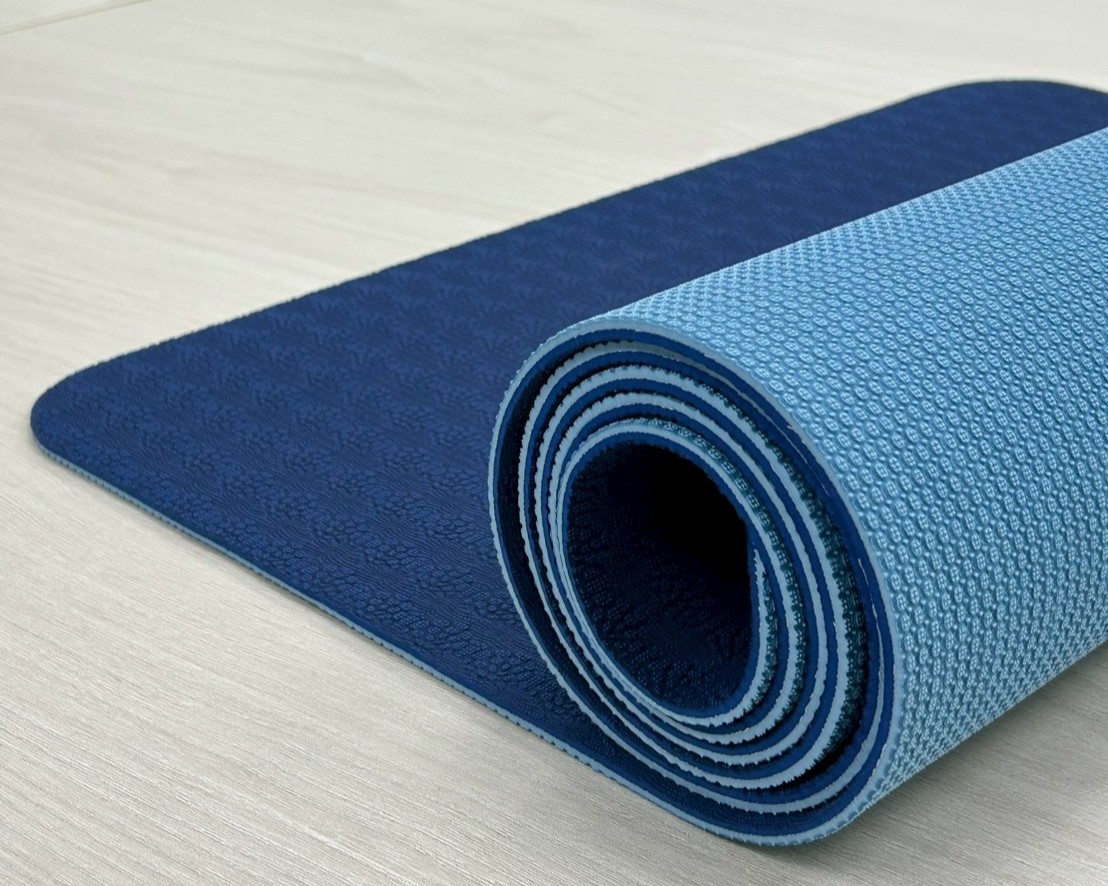
The tighter the roll and the longer the storage, the more curl a mat shows after packaging. A simple bending estimate shows the trend: surface strain is roughly the sheet thickness divided by twice the bend radius. A 5 mm sheet wound at a 40 mm radius sees about 6% strain, while the same sheet at a 60 mm radius sees about 4%. Treat these figures as an illustration of direction, not as measured data.
Specify the roll diameter and the winding direction in the packaging spec.
Laminated Yoga Mat Warping: When Layers Behave Differently
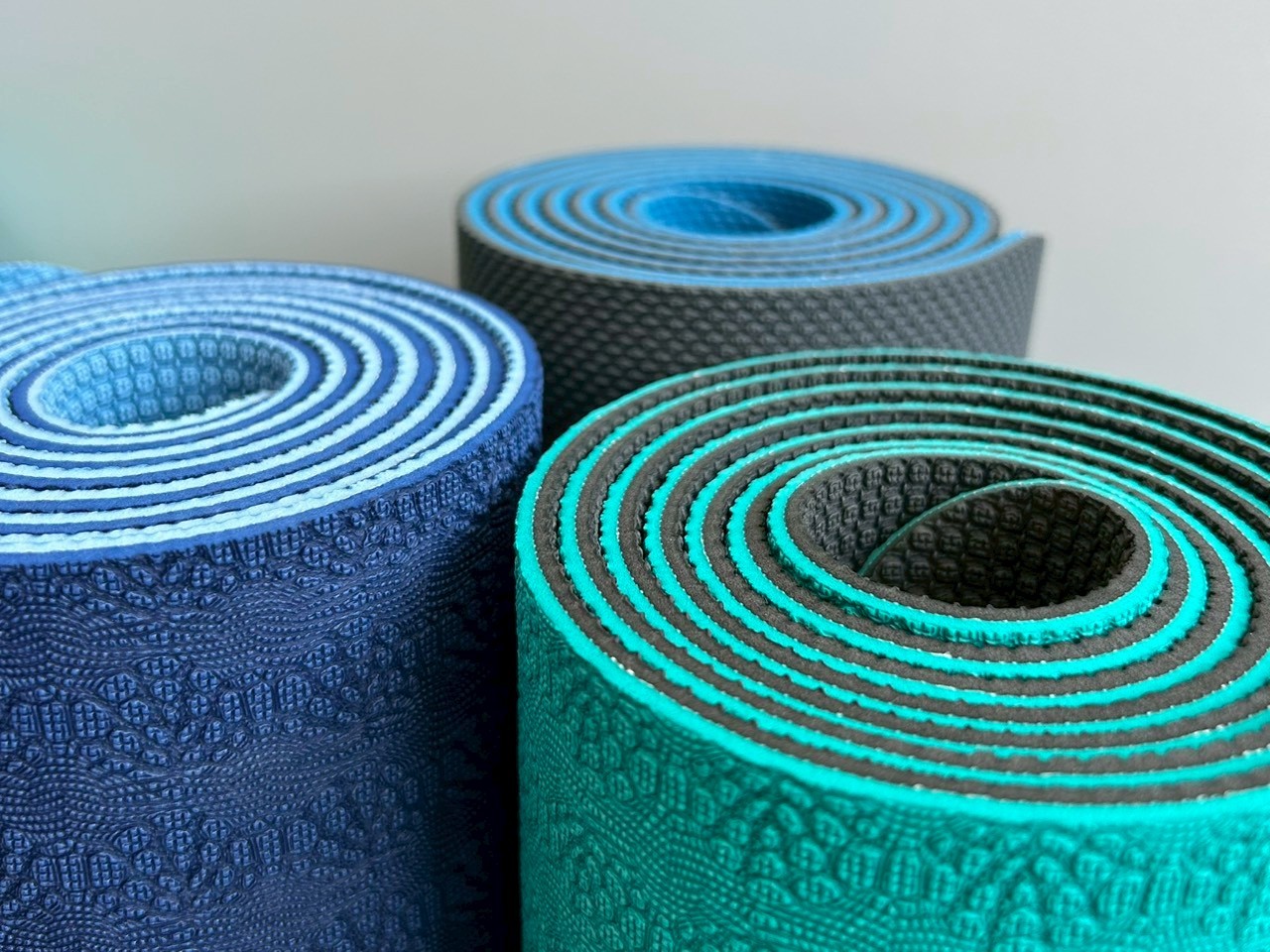
Bonded layers that shrink or recover at different rates cause laminated yoga mat warping. The mismatch acts like a bimetal strip, bending the sheet toward the layer that contracts more.
Layer thickness ratio, material pairing and adhesive cure all influence the result, so request them as part of the construction spec. A single-layer closed-cell foam sheet avoids this mismatch, although it still faces the stresses described above.
Explore yoga mat customization options for your brand
Yoga Mat Curling in Production: Cooling and Conditioning
Production controls are where most curling is prevented. Even cooling after expansion, controlled lamination and thermoforming conditions, and a rest period before cutting and rolling all lower the stress a sheet carries into packaging.
Ask OEM suppliers to state their conditioning time on the spec sheet and keep it consistent across batches.
See the full yoga mat manufacturing process, from foam expansion to packaging
FAQ
Does a yoga mat material comparison show which materials curl least?
Not reliably, because curling depends on how a sheet is made and wound as much as on the base material. Compare thickness, density and layer structure for each candidate rather than materials alone.
Why do yoga mat edges curl up even on new mats?
New mats often hold stress from production and tight roll packaging, which shows up as lifted edges until the sheet relaxes.
Can a thicker yoga mat prevent edge curling?
Not on its own, since thickness raises stiffness and also raises bending strain when the mat is rolled. Pair the thickness choice with a roll diameter and winding direction in the packaging spec.
How does conditioning time affect yoga mat flatness?
A rest period before cutting and rolling gives residual stress time to relax, which reduces lifted edges on arrival.
Struggling with yoga mats from your supplier whose edges keep curling up?
Request a Sample to Check Our Difference
